


Warm Up, Cool Down
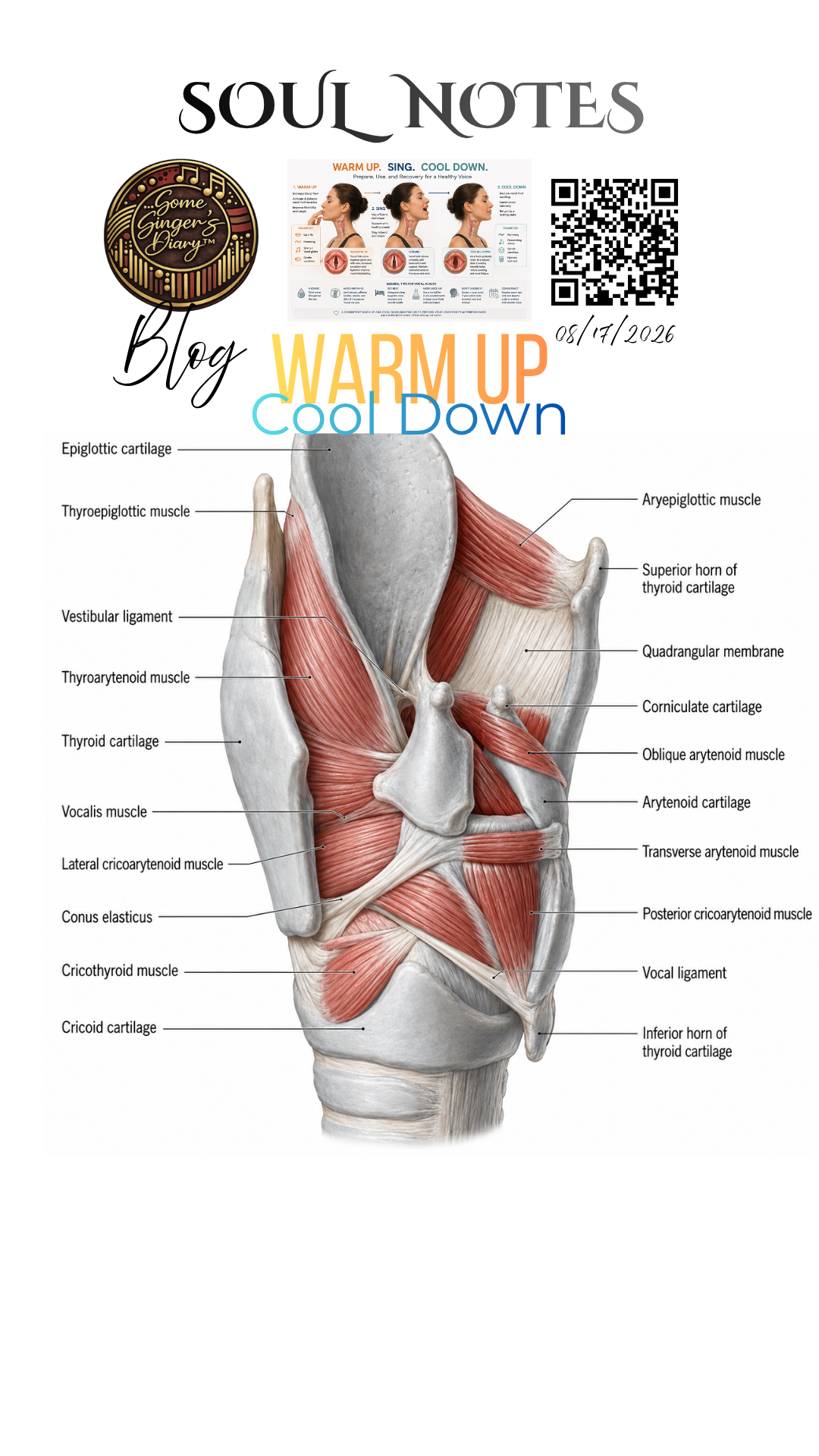
A warm-up exists for a reason before the first rep counts. Cold legs and a hard sprint don't pair well, and the body knows it before the mind does. The voice runs on the same logic — it's a muscle system, not an exception — even though it doesn't always get treated with that in mind before it's asked to perform.
Effort has a shape. The preparation comes before it, the output happens in the middle, and something has to happen after. Each part does different work, and skipping one changes what the middle can actually do.
On stage, that shape has a specific cost. There's a seam in every voice — the passaggio, the spot where control hands off from one set of muscles to another. Getting through it clean has nothing to do with power. It runs on breath: a steady, supported column of air underneath the note, primed before the seam ever arrives. Without that support already online, the body reaches for the wrong fix under pressure. It squeezes. Forces. Tries to muscle across a gap that was never a strength problem in the first place.
That's what the warm-up actually is: rehearsal of a mechanical handoff before it happens live, under pressure, in front of a room that's listening whether it goes right.
The cool-down does a different job, and it's easy to leave out simply because the set feels finished the moment the last chord ends. The muscles that just worked hard stay inflamed and keyed up well after that. Walking straight from a set into silence, or into loud conversation, asks tired tissue to keep working with no transition — the same shift a hard run needs, easing out of it instead of stopping dead. A real cool-down brings the intensity down gradually. Soft glides. Gentle humming. Nothing demanding of an instrument that just did the demanding part.
The stage doesn't let any of this stay theoretical. It's a mirror — whatever's actually been prepared shows up in it, and so does whatever hasn't, in real time, in front of people. This isn't really about singing. It's about the parts of any hard thing that happen before and after the part everyone sees. The middle gets the attention because the middle is visible. The preparation and the recovery on either side of it are what make the middle possible to repeat without cost — visible or not.
I build both ends now, deliberately, the same way I do when I exercise. Not because it's impressive. Because the alternative is paying for it later.
The work isn't finished when the last note lands. It's finished when the instrument has actually come back down.
The Stage Is a Mirror. Stop Auditioning. Stay Curious.
— Charlie Lawrence







 2025 Some Singers Diary
