


Nerves showed up before I did.
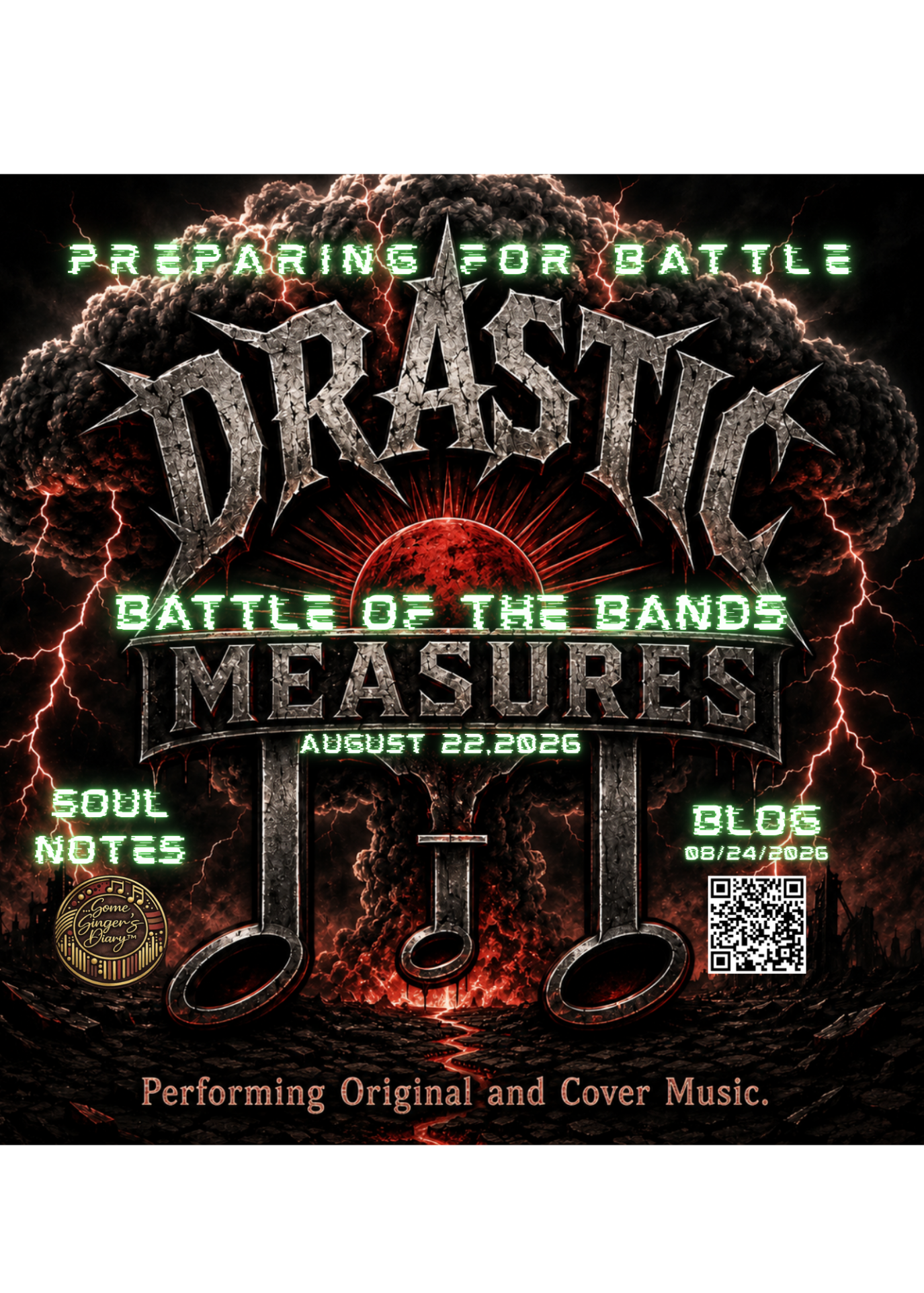
I'd been playing with Drastic Measures for almost two years, but "playing with" is generous. My performance schedule with Tavo Tiki Tunes ate most of my calendar, so I wasn't at practices the way a real member of the band should be. We hadn't played out much either. It was mostly just for fun. Which meant I'd never fully committed the lyrics to memory, never really thought about what my body should be doing on stage while my voice did its job. When the band decided to enter Battle of the Bands, all of that became a challenge I felt the need to address.
From the moment we entered the battle, band practice became non-negotiable. If I could not be there, the fellas agreed to an alternate evening.
I stopped using my iPad.
I created a notebook with the songs for our band practice sessions and marked every place I made a mistake, forgot lyrics, or observed a need to deliver something differently vocally, after every song we practiced in real time. And then I paid more attention to those areas when I was practicing at home alone.
I thought about what the music and lyrics felt like in my body.
I thought about how the singer sang it.
I thought about what the song lyrics meant to me.
I thought about how I would sing it because of how I felt it.
I exercised to build my physical endurance so that I could not just stand on stage and sing, but move and sing at the same time.
I thought about the timing, the energy, the beat.
I held something in lieu of a microphone. I danced around and jumped around so that I would get physically tired while I was singing.
I created cheat sheets in set-list order, with the areas of the songs that I felt I was most at risk of forgetting.
I put the cheat sheets on the floor and practiced almost daily while finding an unobvious way to look down at them if I forgot the lyrics.
When I arrived at the hosting venue, The Rum Bucket Bar and Grill, there wasn't even room to put them on the stage in front of me. It was too tight, so I ended up not using them, but the process still helped with my memorization.
So, I trained for it in my garage like an athlete preparing for a fight I couldn't fully picture yet. I ran the songs on repeat while I exercised, building endurance alongside memory, letting the music live in my legs and lungs before I asked it to live anywhere else.
From a suggestion by our guitar player, Sonny Graham, I made a decision: no more mic stand. In order to increase my familiarity and comfort, I immediately stopped using the mic stand at my consecutive shows with TTT. This allowed me to realize that I had been leaning on it without even noticing how much it was letting me hide. When I feel the music in my body instead of managing it from behind a stand, I found that I sing better. I stop narrating myself as much and start being more inside the song.
I never once thought about the name of my own band until I was standing in the middle of all that training. Drastic Measures. That's what it took.
None of that made the fear smaller. I remember arriving and feeling it clearly: impostor syndrome, the specific flavor of it that asks, what if I can't actually do this, right when it's too late to find out any other way.
I'd played out with the band two or three times before, usually leaning on an iPad at a local spot where the owner knew the drummer. Comfortable, lower stakes, forgiving. This wasn't that. This was the band being seen, and me essentially auditioning in front of people who could actually book us. The foundation of exposure, if there is such a thing.
I genuinely didn't consider a win to be on the table. I perceived that the other bands in the lineup had been actively playing out, building the kind of track record of bookings and gigs that we hadn't. So winning wasn't the goal I was carrying onto that stage. Bringing it, fully, was the goal. Because if I could bring it, maybe that was the beginning of something for our band.
There was another reason the weight of that mattered more than a local competition should. Right now, most of my active income sits in one place, one arrangement, one set of circumstances I don't fully control, and I've learned enough to know that nothing stays fixed forever. If an unforeseen change hit that dynamic and I hadn't built something else standing on its own feet, I'd be the one left making undesirable choices, my plan B, so to speak.
I left the house around three thirty and got lost, taking a detour I didn't need before finally finding the place around four thirty. The bass player, Jimmy Gilliam, the guitarist, Sonny Graham, and the drummer, Jim Good, all arrived around four forty-five. We drew for our spot at five and pulled third.
The first act started at six, and two songs in, it started to rain. The crowd scattered under the tiki bars and whatever cover they could find. We rode it out together, talking, singing anything with the word "rain" in it to pass the time, watching the radar on our phones to see how much longer it would hold and whether the event would have to be rescheduled. But the rain let up, and it was on.
Going third turned out to be a gift I didn't expect. Watching the two bands ahead of us gave me something to react to, a chance to feel what they were doing and sense what I might do differently before I ever stepped up.
What I can't fully put into words is how much anxiety I had to release just to let go and bring it, mind, body, spirit, voice, all of it. The whole point wasn't to control the performance. It was to embody it. To stop asking what it sounded like or looked like from the outside and just feel what it was from the inside. To trust myself and the preparation I actively participated in.
I didn't do that perfectly. There were still a few moments when I went back into my head, a couple of notes I've always been a little scared of. But for the most part, I let go.
At fifty-eight years old, for the first time, I played out with a band, but not just any band. One I was a part of that had real, seasoned stage musicians, in a real, public way, not because someone knew someone, but because we showed up and did the thing.
When they announced that we'd won, to me, it felt like winning the lottery.
Audience participation was a tenth of the judges' score. Maybe one or two people in the whole room were there specifically for us. The judges knew the local scene well. Which means it wasn't a favor. It was earned.
Somewhere in the crowd, a couple recognized me from a solo show I'd played in North Fort Myers years ago. They told me it was like our band was the headliner that night, and that it was like the other bands essentially opened for us. Which, whether we won the evening or not, was something I will hold in my heart with a sense of pride and gratitude for the experience forever.
Preparation is the one thing you can always control, and that's exactly what this was: a fair shot, earned. That's the whole method. Baby steps, every one of them, the same principle I wrote down for myself back in 1990, in a piece called How to Succeed: think your way to success. Henry Ford said it, and I wrote it down decades before I understood it: believe you can, or believe you cannot, either way, you're right. "I could never" was never a fact; it was just an opinion I'd let my subconscious file away as true. And somewhere underneath all of it was the baby learning to walk, falling down again and again, because falling down was never the failure. Stopping is the only thing that ever was. At fifty-eight, I got to prove that to the twenty-two-year-old who wrote it down and hoped, someday, it would be true.
Drastic Measures. Turns out that band name was never just a name.
The Stage Is a Mirror.
Stop Auditioning.
Stay Curious.
— Charlie Lawrence
© 2026 Charlie Lawrence. All Rights Reserved.
…Some Singer's Diary™
Charlie Lawrence | Vocalist
Music, Stories & Moments — From the Stage.







 2025 Some Singers Diary
