

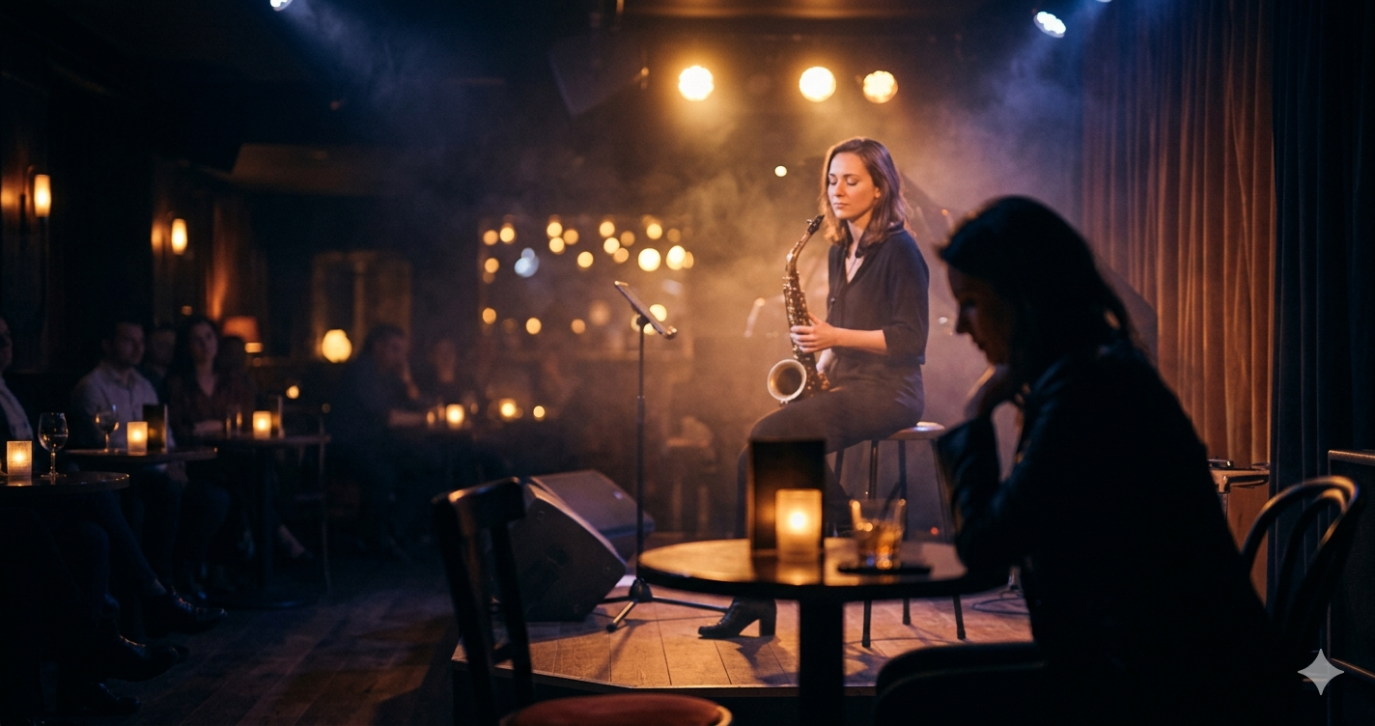

There is a particular kind of information that does not come from books. It does not arrive through practice runs or rehearsals. It develops slowly, almost quietly, through years of being inside rooms where something real is happening.
That is hard to name. But anyone who has time in pressured environments, where emotional stakes are high and composure is not optional — they know exactly what it feels like to use it.
For Charlie, that capacity did not stay in one room. It moved.
Before the Stage, There Was a Different Kind of Presence
Long before music became the primary language, there were environments where reading people correctly was not a soft skill — it was a necessary one. Spaces where the difference between a well-timed word and a poorly placed one could change the entire shape of a moment.
That kind of experience changes the way a person moves through the world. It changes what you notice. It changes your relationship to silence — because it is almost always communicating something.
The Carry-Over That Changes Everything
What happens when that observation enters a creative life? When the person who spent years reading rooms, starts reading rooms from a stage?
The performance becomes less about delivering something and more about exchanging something. The audience is no longer an audience in the traditional sense — they are a room full of information, full of energy, full of moments waiting to be met correctly.
What Live Performance Actually Is
There is a version of performance that is purely technical. Hit the notes. Know the lyrics. Move on cue. Smile at the right time. That version exists, and it has its place.
But there is another version — one that requires a different kind of readiness entirely. To feel the shift in a room when something lands. To recognize when something is not landing and make a quiet adjustment without losing the thread. To know when a lyric is hitting someone in the audience in a way that deserves acknowledgment, even if that acknowledgment is nothing more than a held note or a slowed breath.
The Live Exchange
It is not a broadcast. It is not a one-directional transmission of a finished product. It is a conversation conducted through music, through presence, through the accumulated weight of every honest moment that shaped the material being performed.
The person singing brings their history. The room brings its own. What happens in between is never fully predictable — and that unpredictability is not a problem to be managed. It is the point.
What Gets Built From All of It
When performance is treated as a living document — when every set, every show, every conversation after the last song becomes material — something accumulates over time. Not just a catalog of recordings or a list of venues. Something more layered than that.
A body of work begins to form that is rooted in lived experience, shaped by genuine observation, and grounded in the understanding that creativity and structure are not opposites. They are partners. One without the other produces either beautiful chaos or organized emptiness.
The Elements That Keep Feeding Each Other
- Music as a way of processing what observation alone cannot fully express
- Performance as a real-time laboratory.
- Writing as the space where reflection catches up to instinct
- Structure as the container that makes creative risk feel sustainable
- Lived experience as the source that never runs dry because it is always being added to
This is the ongoing project. Not a single album or a single show or a single story — but a continuous body of work where each piece informs the next, where life and creativity are not separated into different chapters but woven into a single ongoing practice.
The room keeps teaching. The stage keeps offering new pages. And the work of turning what is observed into something that can be felt by another person — that work continues, performance by performance, entry by entry.







 2025 Some Singers Diary
